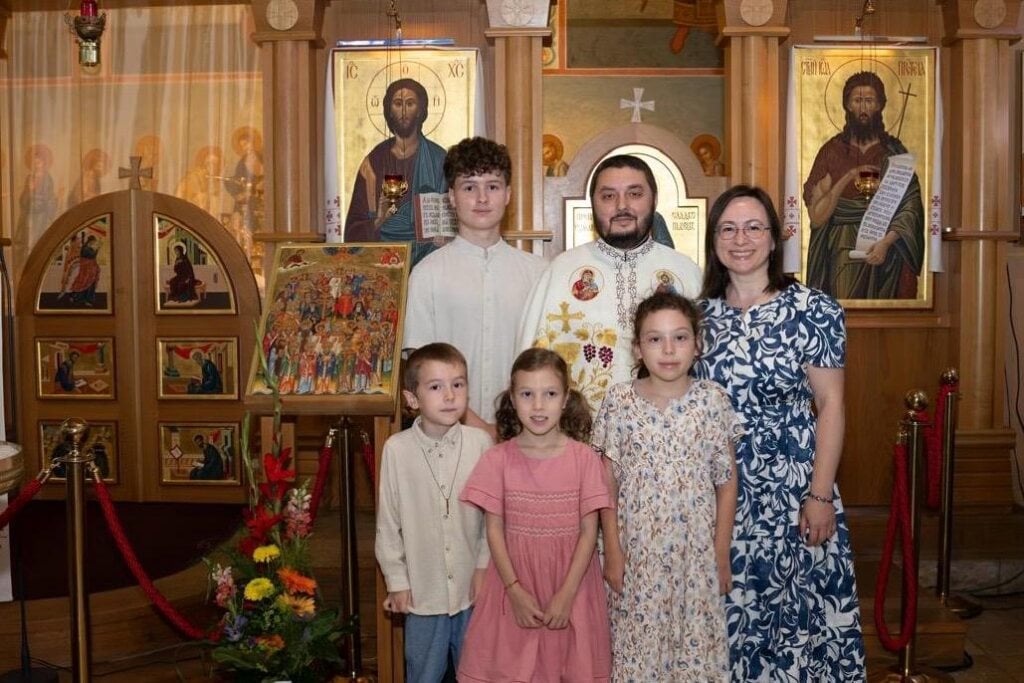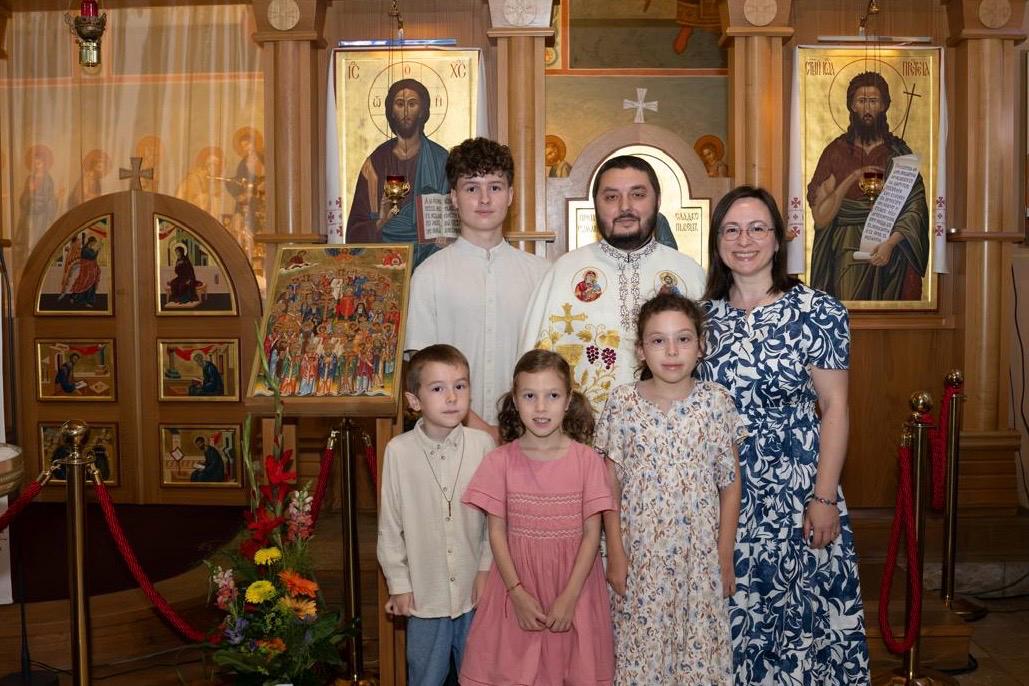
Mihaela-Iuliana Păun is the wife of Fr. Ionuț Păun, the parish priest of the Romanian Orthodox Church dedicated to St. Parascheva and the Holy Martyrs Kilian, Coloman, and Totnan in Bamberg, Germany. She has lived there for almost seventeen years together with her husband and their four children.
She teaches German in adult education, and her experience of closely supporting the growth of a Romanian Orthodox community in the diaspora—with all the joys, sacrifices, and challenges such a mission involves—provides valuable insight.
In this interview, she considers the role of a priest’s wife, the fragile balance between parish and family life, and how living in the diaspora can be both a difficulty and an opportunity to rediscover the treasure of the Orthodox faith.
A parish that grew in the diaspora
Alexandra Nadane: What have been the biggest joys and challenges you’ve encountered during your years in Germany?
Presbytera Mihaela Păun: During the nearly seventeen years we have lived in Germany, we have experienced countless blessings. Above all, there has been the joy of carrying out missionary work in the beautiful region of northern Bavaria. My husband, Fr Ionuț, who had come to study in the university town of Erlangen, was ordained to serve the Orthodox student chapel there, a place where we felt welcome from the very first moment.
Most of the services were officiated in German, as the congregation included not only Romanian students but also Germans, Georgians, Serbs, Bulgarians and Russians. The atmosphere of student life and youthful enthusiasm has left us with many treasured memories.
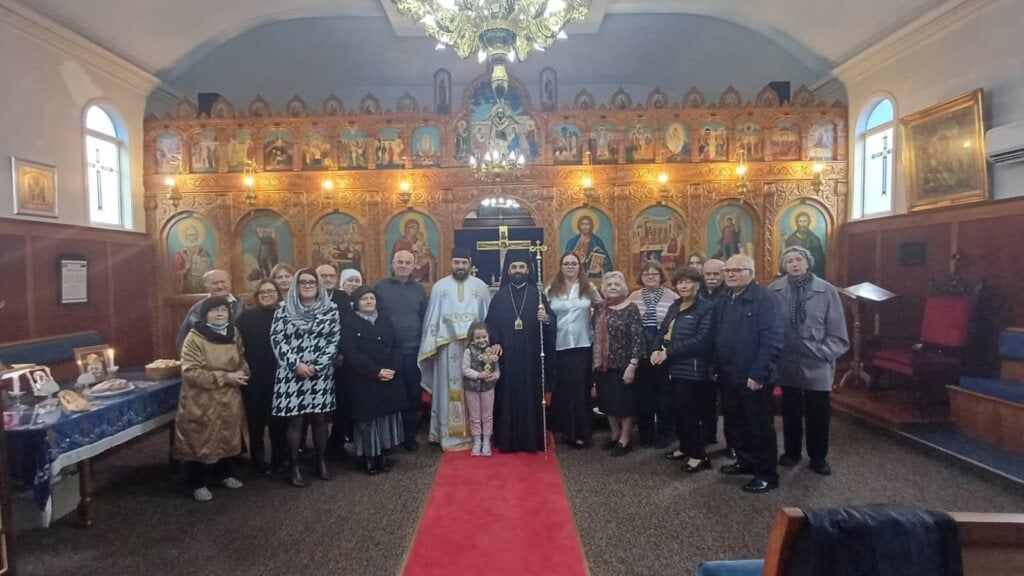
Another great joy—accompanied by constant sacrifice—was witnessing the birth and growth of a Romanian Orthodox community in Germany. I am referring to our parish in Bamberg. After serving at the student chapel, my husband was entrusted with founding a Romanian Orthodox parish in Upper Franconia, in northern Bavaria, where none had existed before.
It truly was a missionary sacrifice because everything had to begin from scratch: finding a place to worship, acquiring liturgical items and, above all, making the parish known, bringing Christ’s message to people and encouraging them to come to church.
My husband travelled tens of thousands of kilometres while trying to combine parish ministry with his university studies and his weekday job. This became the greatest challenge for our family. The parish was growing precisely during the years when our second, third and fourth children were born, one after another, leaving him with very little time for us.
Thankfully, we realised in time the danger that a diaspora parish can pose—the risk of “swallowing up” our own little family. Today, we are able to spend more time together, and that has been a genuine blessing for all of us.
Because of the immense love and self-sacrifice hidden behind our parish, I often call it our fifth child. Ministry in such a parish extends far beyond the liturgical services. Both my husband and I help fellow Romanians integrate into German society—for example, by accompanying them to medical appointments or public institutions as translators.
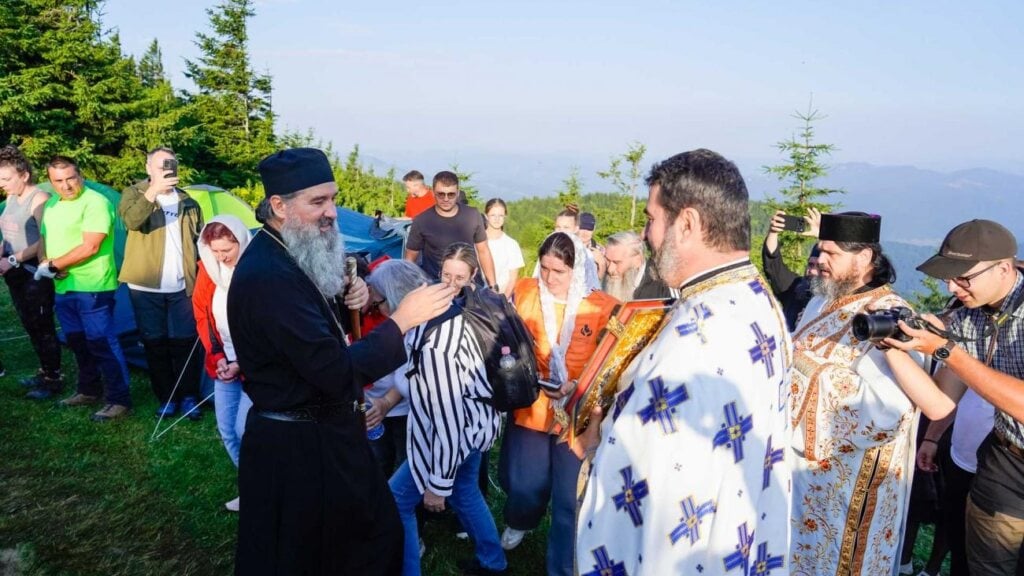
Another source of joy has been seeing how many Germans are interested in learning about our church. Groups of university students, schoolchildren and even nursery children regularly visit us, eager to discover more about Orthodoxy.
We have also witnessed many Germans embracing the Orthodox faith. It is a true privilege to see the joy and conviction with which they enter the Church. Their example continually reminds us what a priceless treasure we possess, something we ourselves sometimes take for granted. Here we also experienced, for the first time, what it means to belong to a religious minority. I still remember neighbours who had never heard of Orthodoxy asking me whether we were Christians.
I am firmly convinced that God brought us to Germany because He knew it would be the best place for us. It has become a country very dear to our hearts, where we have quickly and naturally integrated. It certainly helped that both of us already spoke German and enjoyed many positive interactions with local people. The Germans we met—not only at church, but also through work and our children’s extracurricular activities—have always shown great respect and sensitivity towards people’s private lives.
I also appreciate that all shops are closed on Sundays and that crosses are still displayed in schools, nurseries, hospitals, and other public institutions, at least in our region, where Catholicism remains strong. At the same time, it is well known that both the Catholic Church and the Evangelical Church have experienced significant declines in membership in recent years.
The priest’s wife: between family and community
Alexandra Nadane: How do you view the role of a priest’s wife today, in terms of her family, the parish community, and the realities of the world around her?
Presbytera Mihaela Păun: I believe that the role of a priest’s wife, especially in the diaspora, is to support her husband in the mission entrusted to him. As a result, we often take on responsibilities that, in Romania, would normally be carried out by employed staff. For example, we sing in the choir, organise activities for children through the parish school, help prepare patronal feast celebrations and other parish events, and assist with cleaning and maintaining the church.
I should add one important clarification: every priest’s wife should become involved in accordance with her own strength and resources, taking into account the particular stage of life she is living through. Otherwise, burnout can come very easily. Above all, I believe a priest’s wife simply needs to be present within the community, because parishioners often approach her before they approach the priest himself.
Of course, there have been occasions when I did not know the answer, but then I gladly directed them to my husband. I also think it is very important for a priest’s wife to be discreet and, as far as possible, to treat parishioners with warmth and respect.
Within the family, however, she has a different vocation—that of wife and mother—and this order of priorities should be respected. She must remain attentive to her husband, her children, and her own needs. It is essential that she does not lose herself amid service to the parish community and the many professional and family responsibilities she carries.
As for my own role as a priest’s wife in relation to the society around us, I should say that, thankfully, people here place great value on respecting one’s private and religious life. At work or in my dealings with schools and public institutions, it is generally irrelevant that I am married to an Orthodox priest, especially since many people are unfamiliar with Orthodoxy. However, when Germans ask me about our faith, I gladly answer their questions. They are particularly fascinated by the fact that Orthodox priests are permitted to marry and raise families, unlike Roman Catholic priests.
Motherhood as a journey of maturity
Alexandra Nadane: You are the mother of four children. What has your experience of motherhood been like?
Presbytera Mihaela Păun: My husband and our children—two boys and two girls—are God’s greatest gifts to me, my deepest source of joy and fulfilment, for which I am profoundly grateful. By the age of thirty-six, I already had four children, and that experience matured me enormously and taught me a great sense of responsibility.
The first eleven years after moving to Germany, with babies and young children, were extremely difficult because I spent much of the time on my own. My husband had parish duties, a full-time job and university studies to complete. There were moments when I felt I could no longer carry the cross of family life.
What sustained me was the conviction that nothing truly beautiful comes without sacrifice, and that the Lord gives each person what is ultimately best for them, even when hardships, trials and temptations seem meaningless at first.
It is certainly not easy to combine family life with the responsibilities and sacrifices of serving a diaspora parish while also pursuing my own career as a German teacher in adult education. Gradually, however, I learned that I did not have to be the perfect housewife or the perfect mother—I simply had to be myself. That realisation brought me great peace.
Motherhood, on the other hand, cannot be separated from fatherhood. Both husband and wife are called to share equally in raising and educating their children, and in responding to each child’s unique needs. The joys and the cross of family life must be carried together by both parents. Otherwise, children cannot grow up in a harmonious family or receive the firm foundation they will later need as responsible, well-balanced adults, at peace with themselves and with the world around them.
When a child enters the world
Alexandra Nadane: What would you say to those who find out they are expecting a child but are worried they won’t be able to manage?
Presbytera Mihaela Păun: I believe such fears are entirely understandable, especially when expecting a first child. Young—or not-so-young—parents should never be judged for those fears or for the number of children they decide to have.
A family with many children is not automatically more spiritually mature than one with only two children, for example. However, the sacrifice, patience, energy and resources required of the parents are undoubtedly much greater.
Overcoming the fear of welcoming a child begins with preparing oneself for the vocation of parenthood. Thankfully, today there are countless sources of information and inspiration available.
I believe that a child should come into a family as the fruit of the spouses’ self-giving love and their sincere desire to become parents. Both husband and wife need to understand that bringing a child into the world is a lifelong responsibility. It is a vocation from which one cannot simply resign when difficulties arise or when things do not go as expected.
The genuine love shared by husband and wife, together with their love for the Lord, helps them overcome such moments. In some cases, professional support—such as psychotherapy or marriage counselling—may also be necessary. There are also unforeseen circumstances that can arise during childbirth or later in life, which are entirely beyond our control. In those situations, it is best to entrust ourselves to God’s providence in faith, hope and love.
An encounter that revealed the treasure of Orthodoxy
Alexandra Nadane: Since relocating to Germany, is there an experience that especially touched you and that you’d like to share?
Presbytera Mihaela Păun: Yes, there have been several, but I would like to mention the visit of the renowned theologian Professor Karl-Christian Felmy, from the Chair of Eastern Christian Theology at the University of Erlangen–Nuremberg, and his wife to the student chapel in 2011.
Deacon Vasilij—the baptismal name Professor Felmy received after his conversion to Orthodoxy—concelebrated the Divine Liturgy with my husband. We still remember that service with great affection. It brought us immense joy and deeply honoured us with their presence.
What impressed us most was their openness and humility in their interactions with the students. The Felmy family, themselves converts to Orthodoxy, helped us understand even more clearly our own missionary calling: we possess a treasure that we have the privilege of making known here in the diaspora.
Advice for a priest’s wife at the beginning of her journey
Alexandra Nadane: What advice would you give to a priest’s wife just starting out on this journey?
Presbytera Mihaela Păun: I would encourage her to be authentic—to be herself—and not to fall into the trap of comparing herself with others, not even with other priests’ wives.
There is no formal job description for a priest’s wife that requires her to sing in the choir or clean the church. As I mentioned earlier, each of us is called to serve God and our neighbour sincerely, according to our own gifts, personality, stage of life and love for our husband.
We become priests’ wives through our marriage to a young theologian, so it is a vocation we freely embrace. I would also encourage her to maintain a respectful, discreet attitude in her relationships with parishioners.
People often say that the parish is the priest’s extended family. That is true to a certain extent, but it should never mean that his own family is pushed into second place or allowed to suffer.
It is primarily the priest who is called to balance his ministry in the parish with his ministry within his own home, and that is undoubtedly one of the greatest challenges of priestly life. The priest’s wife, for her part, should help create an atmosphere of peace and love.
Finally, I would warmly recommend that she join the international St Nona Community of Orthodox Priests’ Wives, founded by Prof Cristina Benga. There, she can benefit from the life experiences and advice of other priests’ wives, some of whom have many years of experience. Such support is invaluable—not only at the beginning of the journey but throughout it.
She should never forget that the joy of serving as a priest’s wife is founded upon love: love for God, for her husband, for her children, for her neighbour and also for herself.
“And now these three remain: faith, hope and love. They bind together and sustain all the other virtues, but the greatest of these is love” (cf. 1 Corinthians 13:13).
Photo: personal archive