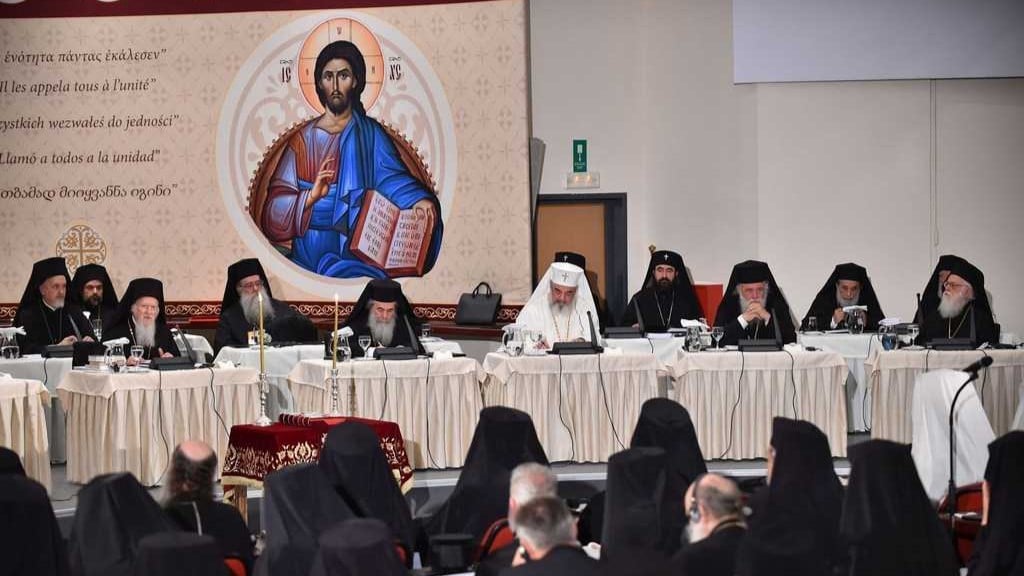
Tuesday, June 16, marks the tenth anniversary of the Holy and Great Council of Crete, the only gathering of its kind held by the Orthodox Church in the 21st century.
The Holy and Great Council of the Orthodox Church brought together hierarchs from ten of the fourteen autocephalous Orthodox Churches on the island of Crete. Its deliberations focused not on liturgical or dogmatic issues, but on the Orthodox Church’s mission in an increasingly globalised and secularised world.
The Council took place at the Orthodox Academy of Crete from June 16 to 26, 2016, under the presidency of His All-Holiness Ecumenical Patriarch Bartholomew I.
The delegation of the Romanian Patriarchate, led by His Beatitude Patriarch Daniel and comprising 25 bishops, participated in all sessions of the Council.
Proceedings of the Holy and Great Council
The Council was preceded, from June 9 to 16, by a drafting committee tasked with preparing the Message of the Holy and Great Council.
Based on this work, the Council produced the Encyclical of the Holy and Great Council, a comprehensive final document that serves as the interpretive framework for all texts adopted during the proceedings.
The final versions of both the Message and the Encyclical were approved during the working session held on June 24, 2016. The Message was read during the Divine Liturgy celebrated at the conclusion of the council’s work, on the Sunday of All Saints.
Although the Council officially concluded on June 26, 2016, its documents continued to be discussed through conferences, local meetings and theological consultations. These discussions occasionally generated divisions and misunderstandings among some faithful regarding the council’s purpose.
The contribution of Patriarch Daniel and the other hierarchs of the Romanian Orthodox Church was significant in affirming Orthodox identity within the context of ecumenical dialogue.
Main Topics Addressed
The Holy and Great Council examined several key issues facing contemporary Orthodoxy, including:
- the unity of the Orthodox Church and the witness of faith;
- the importance of inter-Christian and interreligious dialogue;
- secularisation;
- marriage;
- the natural sciences, technology and the ecological crisis;
- respect for human dignity;
- politics;
- youth and engagement with the modern world.
Although the Patriarchates of Antioch, Moscow, Bulgaria and Georgia did not participate in the council, their observations were incorporated as improvements to the draft documents submitted to the plenary assembly for discussion and approval.
Photo: Basilica.ro Files