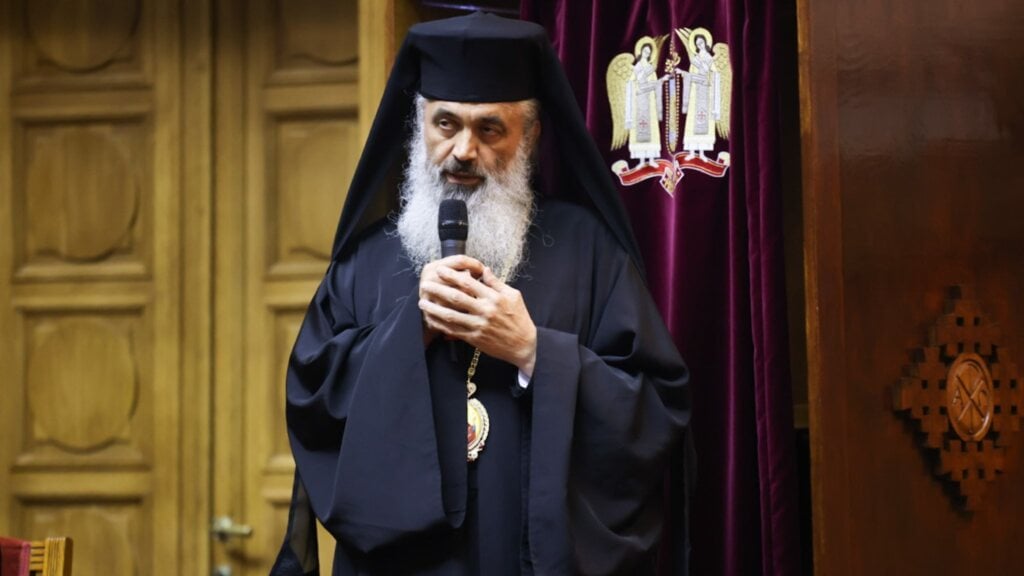
At the conclusion of the “Way of the Saints” procession held in Bucharest to mark the feast of Saint Demetrius the New, Protector of Bucharest, Patriarch Daniel delivered a message highlighting the spiritual connection between Saint Demetrius the New and Saint John Jacob of Neamț. He explained that the lives and witness of these two Romanian saints — separated by centuries yet united in faith and prayer — reveal the continuity of holiness within the Romanian people.
Addressing the thousands of pilgrims who accompanied the holy relics of Saint Demetrius the New and Saint John Jacob of Neamț, the Patriarch emphasised the spiritual meaning of pilgrimage as a journey toward the Kingdom of Heaven.
He called the faithful to deepen their life of prayer, humility, and love, following the example of the two great Romanian saints — living witnesses of the Orthodox faith and models of hesychastic prayer.
The full message of His Beatitude Patriarch Daniel follows below.
Saint Demetrius the New, Protector of Bucharest, and Saint John Jacob of Neamț — Witnesses of the Orthodox Faith and Hesychast Intercessors
Beloved pilgrims,
Pilgrimage to the relics of saints and to holy places is not merely a journey through space, but above all a spiritual journey — an encounter with God’s saints through the grace of the Holy Spirit that springs from prayer. In this sense, the Holy Confessor Priest Dumitru Stăniloae, the greatest Orthodox theologian of the 20th century, recently canonized, said: “We ask for the help of the saints and of the Mother of God, humbling ourselves before them and convinced that we ourselves cannot obtain such great favor from God, because we are not as humble as they are.”
By venerating the relics of the saints, we enter into communion with them, receiving blessings, strengthening our faith, and receiving help on our journey toward salvation.
The year 2025, proclaimed by the Holy Synod of the Romanian Orthodox Church as the Solemn Year of the Centennial of the Romanian Patriarchate and the Commemorative Year of Romanian Orthodox Spiritual Fathers and Confessors of the 20th Century, is a blessed time in which we give thanks for one hundred years since our Church was elevated to the rank of Patriarchate (1925) and 140 years since the recognition of its autocephaly (1885).
Our joy is even greater because on Sunday, October 26, 2025, we will witness a historic and deeply meaningful event: the consecration of the iconography of the National Cathedral, following the consecration of its altar in 2018.
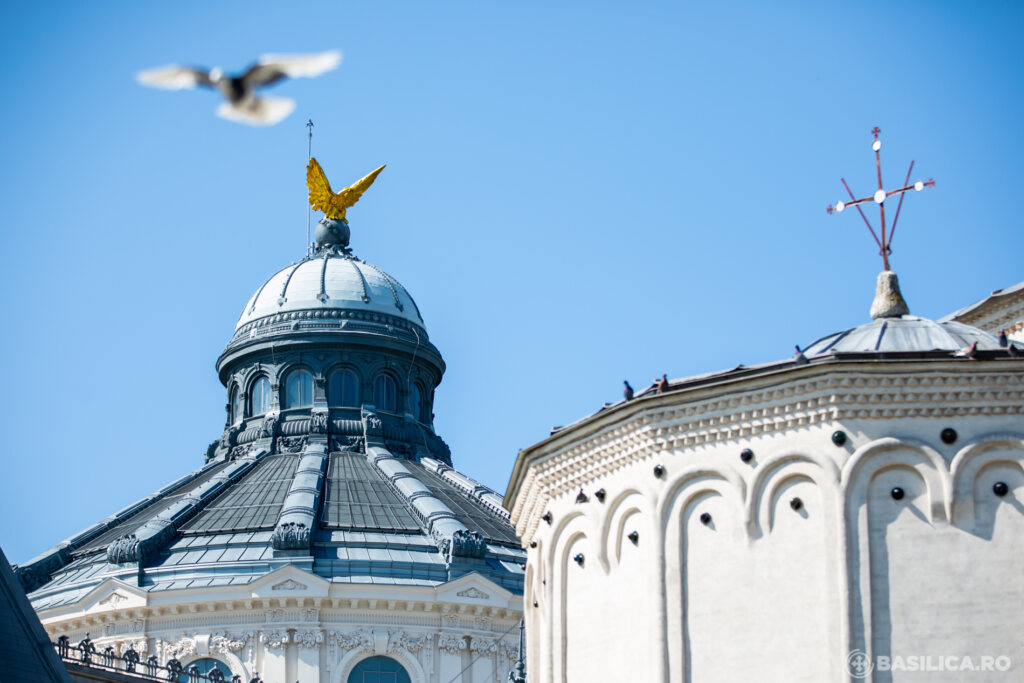
Then, on Monday, October 27, 2025, we will celebrate the autumn patronal feast of the Patriarchal Cathedral, dedicated to Saint Demetrius the New, Protector of Bucharest, and we will have the special joy of placing for veneration, beside his holy relics, a fragment of the relics of Saint John Jacob of Neamț, the New Chozebite, generously offered to the National Cathedral by His Beatitude Patriarch Theophilos III of Jerusalem and All Palestine on November 30, 2018.
Every Christian is a pilgrim on the road to the Kingdom of Heaven, and our encounter with the holy relics of these two great saints strengthens our faith and calls us to live our lives in the love of Christ. Saint Demetrius the New and Saint John Jacob the Chozebite of Neamț are for us great confessors of the true faith and examples of unceasing prayer.
Faithful Christians,
Saint John Jacob the Romanian of Chozeba (1913–1960), canonised by the Romanian Orthodox Church in 1992 and by the Patriarchate of Jerusalem in 2016, is a shining model of hesychastic life and humble love for Christ in the 20th century.
Born in the village of Crăiniceni, Botoșani County, and baptised Ilie, he was orphaned at a young age (his father, Maxim, died in World War I) and was raised by his grandmother, Maria. From his youth, he felt a profound calling to prayer and purity of heart.
At the age of 20, he entered Neamț Monastery, where he was lovingly received by the abbot at that time, Bishop Nicodim Munteanu, who would later become the second Patriarch of Romania. In 1936, he was tonsured a monk, receiving the name John, under the spiritual guidance of Hieromonk Ioachim Spătarul.
With the blessing of Metropolitan Nicodim Munteanu of Moldavia, in November 1936, the young monk John departed with two other monks for the Holy Land, where our Lord Jesus Christ was born, suffered, and rose from the dead.
After two years in the desert, Saint John Jacob reached Saint Sava Monastery near Bethlehem, where he laboured for eight years. In 1947, he was ordained a priest in the Church of the Holy Sepulchre and appointed abbot of the Romanian Hermitage of Saint John the Baptist in the Jordan Valley.
For five years, he celebrated the Divine Liturgy daily in Romanian, translated texts from the Holy Fathers, wrote spiritual poetry, and received Romanian pilgrims with love, hearing their confessions and giving them Holy Communion.
In November 1952, together with his disciple Ioanichie Pârâială, Saint John withdrew to the desert of Chozeba, settling in the Cave of Saint Anna, which belonged to Saint George Chozebite Monastery.
The cave stood on the banks of the brook Cherith, the very valley where the Prophet Elijah once lived as a hermit. There, in complete silence and poverty, Saint John Jacob spent the last eight years of his life in unceasing prayer and strict fasting, eating only bread and water.
On August 5, 1960, at only 47 years old, Saint John Jacob gave his soul into the hands of the Lord. He was buried in the cave of his ascetic struggle, where his body remained for 20 years. When his tomb was opened in August 1980, his body was found whole, incorrupt, and fragrant.
On August 15, 1980, his holy relics were carried in solemn procession to Saint George Chozebite Monastery, where they remain to this day, venerated by Orthodox pilgrims from all over the world.
The Holy Synod of the Romanian Orthodox Church canonised him on June 20, 1992, establishing August 5 as his feast day. He is known as Saint John Jacob of Neamț, or the Chozebite, being the first and, so far, the only Romanian whose sanctity has been proclaimed by the Patriarchate of Jerusalem on the soil of the Holy Land.
In his poetic writings, Saint John Jacob expressed his deep love for Christ, his longing for his homeland, and his fervent prayers for Romanians living far from their native country.
Beloved faithful,
The presence of a fragment of Saint John Jacob’s relics at the historic Patriarchal Cathedral, alongside those of Saint Demetrius the New, Protector of Bucharest, is a great spiritual joy for all of us. This encounter of two great Romanian saints—one from the 13th century and one from the 20th—reveals the continuity of holiness within the Romanian people and strengthens our faith.
Saint John Jacob the Chozebite is a shining model for our times—a spiritual father and confessor of the 20th century who chose the path of solitude and unceasing prayer. His life teaches us that, regardless of the times we live in or the trials we face, the call to holiness remains the same. He shows us that humility, heartfelt prayer, fasting, and detachment from passions lead to full communion with the Holy God.
Together with Saint Demetrius the New, whose relics have been enshrined in the Patriarchal Cathedral for 251 years, Saint John Jacob calls us to a life of prayer and purity, humility and merciful love. Both chose the monastic path —the struggle of the Spirit of Christ —becoming shining lights for all of us.
These saints call us to cooperate with God’s grace—to sanctify our lives through prayer and repentance, through participation in the Holy Mysteries, humility, and works of merciful love toward others.
Beloved pilgrims,
Our pilgrimage to honour the saints of the Church is an act of faith and gratitude. By venerating the relics of the saints, we unite with them in prayer and receive their blessing and spiritual help.
Saint John Jacob, who during his earthly life prayed constantly for the Romanian people and for all those in need, continues even now, from the light of the Kingdom of Heaven, to intercede for us before the Most Holy Trinity together with all the saints.
The life of Saint John Jacob teaches us that preserving our Christian and Romanian identity is a sacred duty, especially in times when many of our people live far from their homeland. He himself was always a pilgrim—far from his native soil, yet never far from Christ or from love for his people.
Through his ceaseless prayers and his ascetic struggle in the Chozeba cave, he united earth with heaven, the Holy Land with Romania, and the past with the present and the future in the light of Christ, who is “the same yesterday, today, and forever” (Hebrews 13:8). His exhortation to all Romanians living abroad remains:
“Exiled sons of my country,
Troubled among strangers afar,
Never forget your holy calling—
As Romanians and as Christians are.” (Brotherly Exhortation)
Keeping in mind the example of these two great saints—Saint Demetrius the New and Saint John Jacob of Neamț—before whose holy relics we bow in these blessed days, let us follow their humility, prayer, and merciful love, so that each of us may rejoice in their help and protection.
In conclusion, we pray to our Lord Jesus Christ, to the Mother of God, to Saint Demetrius the New, Protector of Bucharest, to Saint John Jacob of Neamț, and to all the Romanian spiritual fathers and confessors of the 20th century, to grant us all bodily and spiritual health, strength in trials, and joy in life.
We also thank God for the 100 years of the Patriarchate and 140 years of autocephaly of our Church, which have brought many spiritual blessings to the Romanian people. Let us rejoice in the saints whom God has given to our nation and honour them with deep reverence and Christian love.
May the prayers of all the saints accompany us in life, enlighten our path, and help us reach the joy of the Kingdom of Heaven, to the glory of the Most Holy Trinity and our salvation. Amen!
† DANIEL
Patriarch of the Romanian Orthodox Church
Photo: Basilica.ro / Mircea Florescu