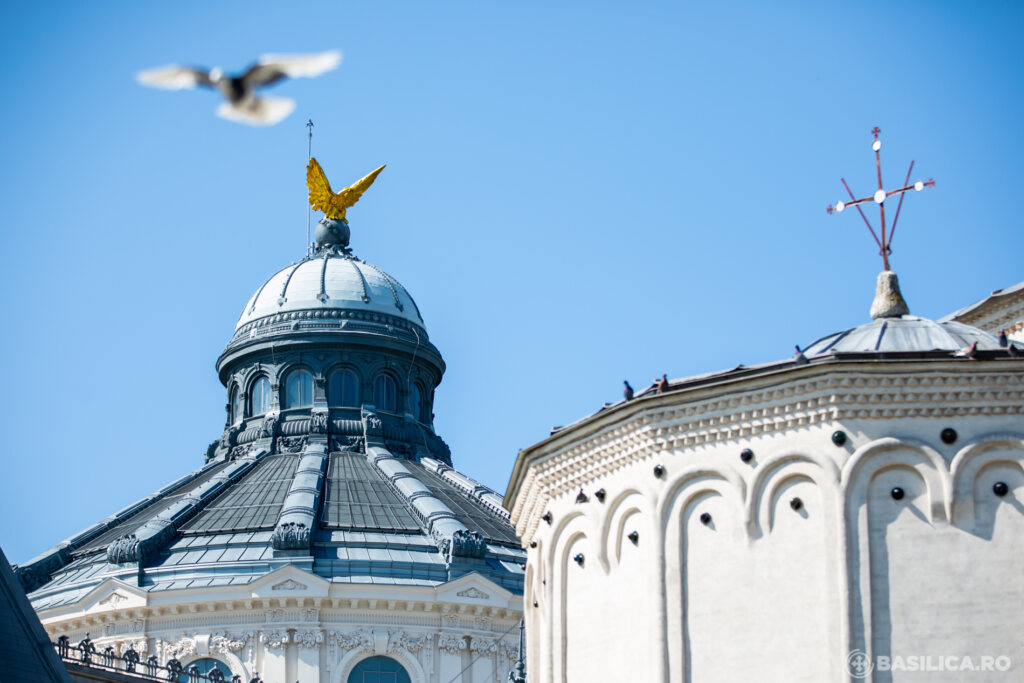
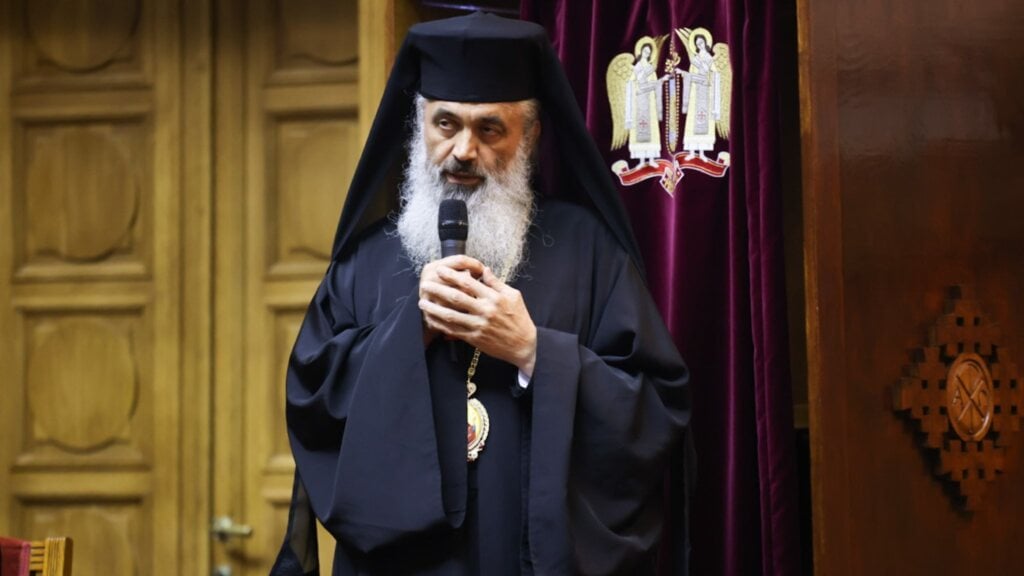
At the historic patronal feast of the Patriarchal Cathedral in Bucharest, His Beatitude Patriarch Daniel spoke about the deep respect that Emperor Constantine the Great showed toward bishops persecuted by his predecessors.
Recalling the 1,700th anniversary of the First Ecumenical Council, the Patriarch emphasized that Saint Constantine initiated and presided over the ecclesiastical event.
“When he opened the council, he did not sit on the throne but stood out of respect for the many bishops who had been persecuted. Some had lost an eye, others an arm or a leg, because they were mutilated and beaten during the anti-Christian persecutions,” Patriarch Daniel explained.
Faith Strengthened by Victory
The Romanian Patriarch explained that Constantine’s faith deepened after his victory over Emperor Maxentius.
“Saint Constantine the Great, seeing that he defeated an army much larger than his own, realized that the help came directly from Jesus Christ. That is why he became a lover of Christ and a supporter of the Christians who were being persecuted,” said His Beatitude.
The following year, in 313, along with Eastern Emperor Licinius, Constantine issued the Edict of Milan, granting religious freedom to all citizens of the Roman Empire.
“This edict of tolerance or freedom for all inhabitants of the Empire meant a great deal. It marked the end of the persecutions against Christians,” explained the Romanian Patriarch.
A Work of Restoration
Beyond ending persecution, Constantine also restored Church property confiscated during earlier persecutions, recalled exiled clergy, and even donated public buildings, called basilicas — “the Emperor’s house” — to be converted into churches.
“Saint Constantine carried out a restorative work. He paid for or compensated the damages inflicted on Christians by previous emperors, who were persecutors,” Patriarch Daniel noted.
Christian Ethics in Imperial Law
The Emperor also offered material support to the Church for aiding the poor, orphans, and widows and enacted social laws to protect the vulnerable.
“He strengthened the Christian family and prohibited adultery and the killing of infants or abortion — practices widespread in the pagan Roman Empire. In 321, he established Sunday as a day of rest throughout the Empire,” added His Beatitude.
The Patriarch highlighted Constantine’s effort to give a Christian character to Roman law, abolishing torture, crucifixion, limb mutilation, and branding.
“He did this because all such acts humiliated the image of God in man,” said the Patriarch.
Saint Helena: Builder and Mother
In his sermon, Patriarch Daniel praised Saint Helena, Constantine’s mother, for her spiritual and architectural contributions.
After discovering the Holy Cross in Jerusalem, she began the construction of the Church of the Holy Sepulchre. She also built:
- A church on the Mount of Olives, marking Christ’s Ascension;
- A church in Gethsemane, where the Virgin Mary’s tomb is believed to be located;
- A church in Bethlehem, the site of Christ’s birth;
- And one in Nazareth, His childhood home.
“She wanted to show her reverence for the Holy Places,” the Patriarch said.
Saint Helena also stands as a model of motherhood and education: “She raised and inspired her son in the governance of the empire and had great piety,” said Patriarch Daniel.
Ties to Romanian History
The Patriarch also emphasized Constantine’s ties to Romanian lands, noting that his birthplace was Naissus, in the Roman province of Dacia Mediterranea — now Niš, Serbia — not far from Dacia Felix.
He recalled that Constantine reconquered Romanian territory from the Goths and secured peace with them, provided they no longer persecute Christians.
The festive liturgy was celebrated at the outdoor altar of the Patriarchal Cathedral, with ten other Romanian bishops concelebrating. The service concluded with the announcement of winners from two national competitions organized by the Romanian Patriarchate.
Photo: Basilica.ro / Raluca-Emanuela Ene