Orthodox Calendar, September 6
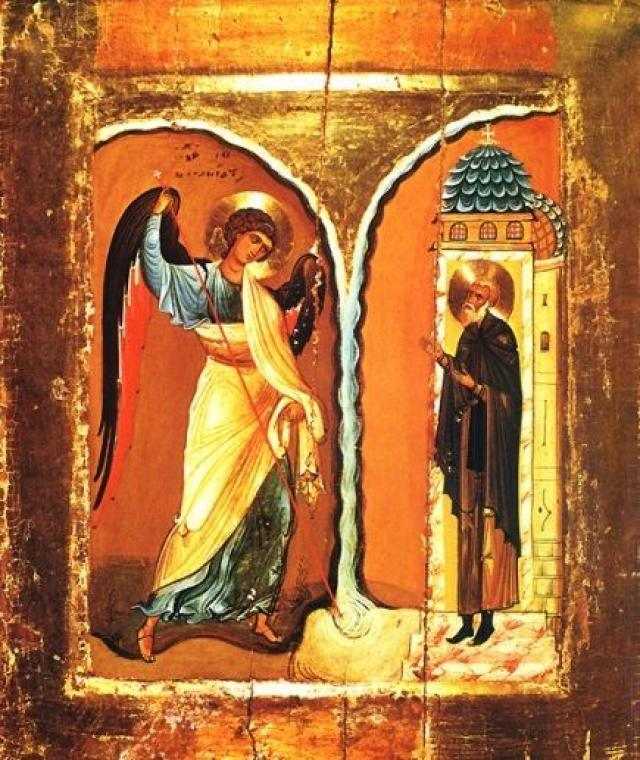
Commemoration of the Miracle of the Archangel Michael at Colossae
In Phrygia, not far from the city of Hieropolis, in a place called Cheretopos, there was a church named for the Archangel Michael, built over a miraculous spring.
This church was built by a certain inhabitant of the city of Laodicia in gratitude to God for healing his mute daughter. The holy Chief Commander Michael appeared to this man in a dream and revealed to him that his daughter would receive the gift of speech after drinking from the water of the spring. The girl actually did receive healing and began to speak.
After this miracle, the father and his daughter and all their family were baptized. In fervent gratitude, the father built the church in honour of the holy Chief Commander Michael. Not only did Christians begin to come to the spring for healing, but also pagans. In so doing, many of the pagans turned from their idols and were converted to faith in Christ.
At this church of the holy Chief Commander Michael, a certain pious man by the name of Archippus served for sixty years as church custodian. By his preaching and by the example of his saintly life he brought many pagans to faith in Christ. With the general malice of that time towards Christians, and especially against Archippus, the pagans thought to destroy the church in order to prevent people from coming to that holy place of healing and at the same time kill Archippus.
Toward this end they made a confluence of the Lykokaperos and Kufos Rivers and directed its combined flow against the church. Saint Archippus prayed fervently to the Chief Commander Michael to ward off the danger. Through his prayer, the Archangel Michael appeared at the temple, and with a blow of his staff, opened a wide fissure in a rock and commanded the rushing torrents of water to flow into it.
The temple remained unharmed. Seeing such an awesome miracle, the pagans fled in terror. Archippus and the Christians gathered in church glorified God and gave thanks to the holy Archangel Michael for the help. The place where the rivers plunged into the fissure received the name “Chonae”, which means “plunging.”
The Martyrs Eudoxius, Zeno, Macarius
The Martyrs Eudoxius, Zeno, Macarius and their Companions received a martyric death for Christ under the emperor Maximian Galerius, the successor of the emperor Diocletian.
Saint Eudoxius held the high position of a military commander in the imperial armies. He was a Christian, as were his friend Zeno and his house steward Macarius. After the emperor Diocletian issued an edict that Christians who refused to offer sacrifice to idols were to be put to death, many people fled to various lands with their families to avoid torture and death. At this time Saint Eudoxius resigned his high position, and with his wife Saint Basilissa and all their family abandoned their property and went into hiding in the region of Armenian Melitene.
The governor of Melitene sent soldiers to search for Eudoxius. When they found Eudoxius, he was attired in white garb. Not recognising him, the soldiers began to question whether a certain military commander Eudoxius had come into these parts. Not revealing who he was, the saint invited the soldiers into his home, fed them and gave them lodging for the night.
Saint Eudoxius considered his encounter with the soldiers as a sign from the Lord of his impending death by martyrdom. In the morning, he disclosed to his guests that he was the one whom they were seeking. In gratitude for the hospitality, the soldiers offered to conceal from the authorities that they had found Saint Eudoxius. However, the saint would not consent to this.
Setting his affairs in order, he told his wife not to weep for him, but on the contrary to celebrate the day of his martyric death. Donning his military garb, he went with the soldiers to the governor. Saint Basilissa and his friends Saints Zeno and Macarius followed after Saint Eudoxius.
The governor tried to persuade Saint Eudoxius to offer sacrifice to the idols and by this safeguard his life, exalted rank and property. Saint Eudoxius firmly refused, denouncing the folly of anyone who would worship soulless idols. He removed his soldier’s belt, the emblem of his authority, and threw it in the governor’s face.
Soldiers present at this, secret Christians, did the same thing, and they numbered more than a thousand men. The embarrassed governor asked the emperor what he should do. He was ordered to try the ringleaders and set the others free.
After prolonged tortures, they led Saint Eudoxius forth to execution. Following after her husband, Saint Basilissa wept, and his friend Saint Zeno also wept for the martyr. Saint Eudoxius again urged his wife not to mourn him, but rather to rejoice that he was worthy of the crown of martyrdom. He asked that she bury his body in a place called Amimos.
To his weeping friend Saint Zeno Saint Eudoxius predicted that they would enter the Kingdom of Heaven at the same time. Emboldened by these words, Zeno loudly declared himself a Christian, for which he was immediately sentenced to death.
Later, Saint Basilissa took her husband’s body without hindrance, and buried it in the place where he had requested. After this, they arrested the saint and led her before the governor. Desiring to share the fate of her husband, she fearlessly denounced both the governor and his false gods, the idols. The governor, however, saw her intent and would not torture her, but instead sent her away. As she left, the saint said to him that God would see her intention to suffer for her faith and would accept this intent as an accomplished deed.
Seven days later, Saint Eudoxius appeared to his wife in a vision and bade her to inform his friend and house steward Macarius, that both he and Saint Zeno awaited the arrival of Macarius. Macarius immediately went to the governor and declared himself a Christian, for which he was sentenced to death and beheaded. Many Christians also suffered martyrdom during this time.
Troparion — Tone 4
Your holy martyrs Eudoxius, Zeno, and Macarius, O Lord, / through their sufferings have received incorruptible crowns from You, our God. / For having Your strength, they laid low their adversaries, / and shattered the powerless boldness of demons. / Through their intercessions, save our souls!
Tr. by oca.org