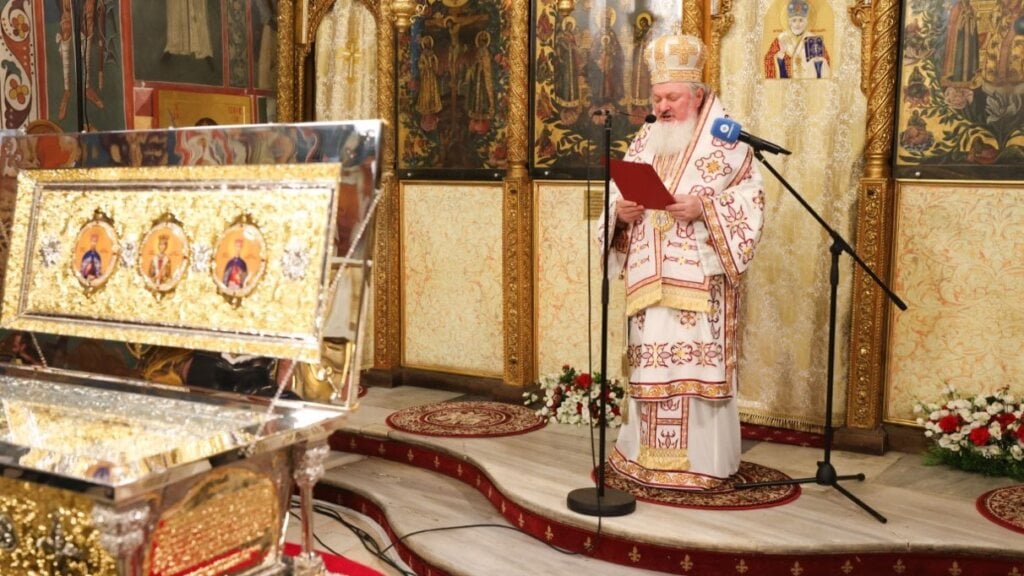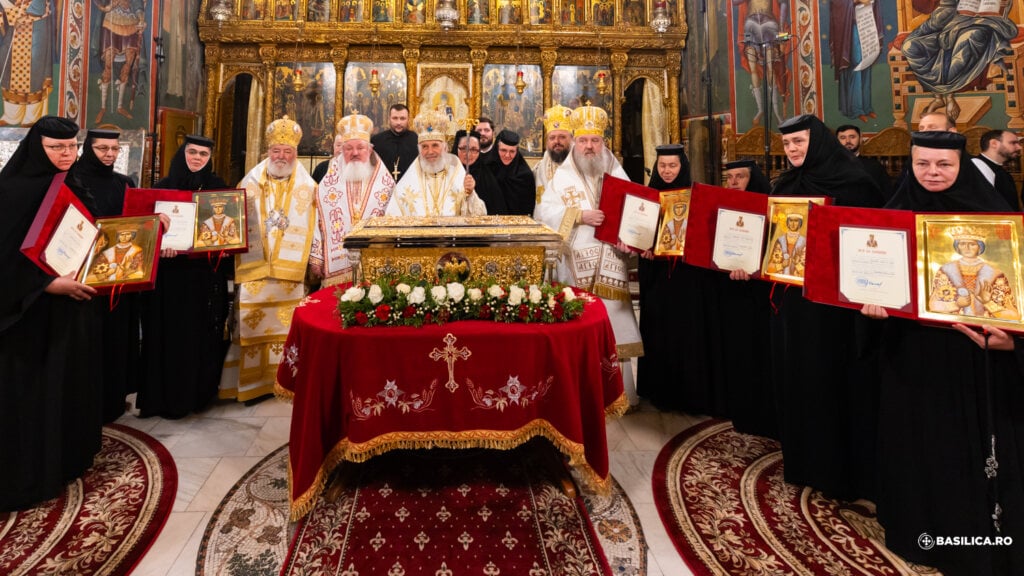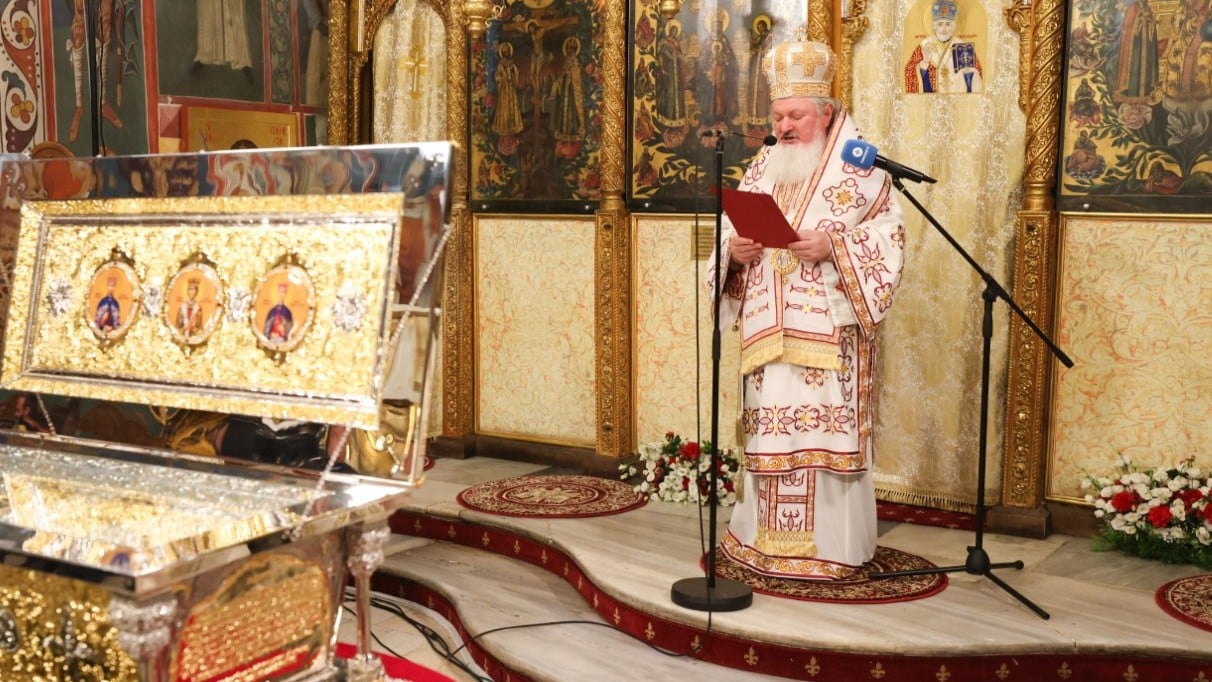
His Beatitude Patriarch Daniel of Romania described Saint Maria Brâncoveanu as a model of Christian faith and courage whose trust in God enabled her to endure the martyrdom of her husband and four sons, years of captivity and exile without falling into despair.
In a message delivered on Sunday at the local proclamation of her canonisation, the Patriarch of Romania highlighted three defining aspects of the saint’s life: her vocation as a faithful wife and mother, her “martyr-like patience” amid profound suffering, and her generosity towards the Church and the Romanian people.
Saint Maria’s strength, Patriarch Daniel noted, came from an unwavering faith expressed not merely in words but through her actions in the most difficult circumstances. Her example subsequently became a source of hope for her surviving family and, through the preservation of her memory, for generations of Romanians.
The message was delivered by Patriarchal Auxiliary Bishop Varlaam of Ploiești, general secretary of the Holy Synod.
Saint Maria Brâncoveanu – a model of faith, patience and generosity
Today, with devotion, we duly honour Saint Maria Brâncoveanu, wife of the Holy Martyr Prince Constantine Brâncoveanu, Princess of Wallachia and mother of eleven children. In the life of this holy woman, we see the radiant image of a faithful wife and mother, a model of martyr-like patience in suffering and an example of generous love for the Church and the people.
Thus, in Saint Maria Brâncoveanu, we see that her love for God strengthened her to bear an incomparable sorrow with faith, becoming a source of hope for her daughters and sons-in-law.
1. A faithful wife and mother
Raised at the princely court of her grandfather, Prince Antonie Vodă of Popești, Saint Maria Brâncoveanu learned from childhood to lead a life of moderation, far removed from the splendour and extravagance that her rank would have permitted.
This quiet schooling in moderation and good order bore abundant fruit later, when the young Maria, having become Princess of Wallachia after her marriage to Prince Constantine Brâncoveanu, had to shoulder the weight of a princely household filled with responsibilities. She never took pride in the splendour of her rank, but throughout her husband’s reign remained a humble and generous woman, attentive to the needs of those around her, whether clergy, boyars or ordinary people.
Blessed by God with eleven children, four sons and seven daughters, Saint Maria Brâncoveanu was a good mother and a faithful wife. Her concern for her children’s education was directed above all towards planting in their souls love for God and for their fellow human beings.
Together with her husband, she brought highly accomplished teachers to the princely court, scholars who taught at the renowned princely academy attached to St Sava Monastery, so that their sons and daughters might acquire knowledge of the classical languages and a profound secular and theological education.
Saint Maria Brâncoveanu also proved to be a wise householder and a skilled administrator of the family’s estates, knowing in detail the purpose of each property and of every sum entrusted for safekeeping to banks in the West. Through this practical wisdom, she enabled her husband to devote himself fully to the affairs of the country, knowing that the household and its wealth were in safe hands.
This combination of practical judgement and spiritual devotion reveals a personality capable of responding to both the demands of her rank and her inner calling toward the spiritual life.
Moreover, her generosity towards others also appeared in small but meaningful gestures. On the great feasts, she would personally offer carefully chosen gifts to the clergy and to her children’s teachers as a sign of appreciation for their work. These deeds, preserved in the memory of her contemporaries, portray a wise woman who knew how to unite the dignity of her rank with the simplicity of a grateful heart.
2. Suffering and martyr-like patience
The second part of Saint Maria Brâncoveanu’s life was overshadowed by a trial so terrible that the human mind can scarcely comprehend its magnitude.
On 25 March 1714, Sultan Ahmed III (1703–1730) ordered the arrest of the entire princely family.
They confiscated their property, and Saint Maria, along with her husband, sons, daughters, sons-in-law, and faithful counsellor, were taken to Constantinople. Imprisoned in the Fortress of the Seven Towers, the Holy Prince Constantine Brâncoveanu and his sons were subjected to indescribable torture in an attempt to force them to reveal where the family’s wealth had been hidden.
On 15 August 1716, before representatives of Europe’s great royal houses, the Holy Prince Constantine Brâncoveanu, as he reached the age of sixty, saw his counsellor and his four sons beheaded before he himself received the crown of martyrdom.
Lady Maria was imprisoned at the time of this terrible massacre and received the news only after it had taken place, news which caused her a sorrow that she would carry in her soul until the end of her life. Who can put into words the anguish of a mother who is told that her husband and four sons have been killed, without even having been there to see them in the hour of their death?
Princess Maria’s suffering, however, did not end there. Together with one daughter, two grandchildren and her sons-in-law, she remained in captivity, under the constant threat of imminent execution, a rumour deliberately spread to intensify the terror and extract information about the family’s remaining hidden wealth.
Her two grandchildren were made slaves by a merciless decree, and their freedom was secured only later through gifts offered to the Sultan’s mother.
Eventually, the family was ransomed for an enormous sum, borrowed at an oppressive interest rate. Even then, however, they were not permitted to return immediately to their homeland; instead, they were forced into three years of exile in the distant regions of Anatolia because of the Cantacuzino family’s intrigues.
Thus, year after year, the humiliation of captivity, uncertainty about the future and estrangement from her native land were added to the grief of losing her husband and four sons.
What transformed this suffering from a great human tragedy into a truly holy sacrifice, however, was the manner in which Saint Maria Brâncoveanu bore it. She endured these trials with strength of soul and trust in God’s mercy.
Although Princess Maria physically survived the death of her family, in her soul she died many times: once for every head that fell beneath the executioner’s sword, for each of the four sons whom she had carried in her womb and raised in the love of Christ, and once more for the beheading of her husband. Such spiritual anguish was experienced as a form of spiritual martyrdom.
Having endured this suffering with martyr-like patience, Saint Maria Brâncoveanu, with great courage, around the year 1720, braving grave dangers and acting in the utmost secrecy, succeeded in bringing the relics of her husband and sons to Wallachia, placing them in the ground beneath the church of the New St George Monastery in Bucharest, a foundation of the Brâncoveanu family.
3. Generous love for the Church and the people
Saint Maria Brâncoveanu’s merciful love for the House of God was also expressed through her work as a founder and benefactor of numerous monasteries and churches throughout the country, from the infirmary of Hurezi Monastery, built to care for elderly and sick people without material means, to the rebuilding in durable stone of old places of worship previously constructed of wood.
Among Saint Maria Brâncoveanu’s foundations, we may mention St Nicholas “Dintr-o Zi” Church in Bucharest, Berivoii Mari Monastery in Brașov County, Viforâta Monastery in Dâmbovița County, the infirmary of Hurezi Monastery and Surpatele Monastery in Vâlcea County.
These foundations are the living expression of a heart that sought to care for those who suffered, those who served the Lord and the people whom she wished to strengthen in faith.
Thus, Saint Maria Brâncoveanu was not merely a mother in the strictly biological sense, but also a spiritual mother of the entire people she served through her generosity and devotion: a devout, industrious, and merciful Christian princess.
Princess Maria Brâncoveanu’s strength to bear the cross of suffering came solely from her unwavering faith, a faith expressed not only in words but lived and confessed through deeds in the most difficult circumstances imaginable.
From the whole course of her life, it is clear that the spiritual steadfastness in the Orthodox Christian faith shown by her husband and sons in the face of death was no accident, but the fruit of a foundation patiently laid within the family, a foundation to which Saint Maria Brâncoveanu made a decisive contribution.
Saint Maria Brâncoveanu’s courage was manifested in steadfastness sustained over many years of trial, a light that became, especially for the other members of her family who remained in detention, a great source of support.
At a time when fear, despair and the temptation to betray the Christian faith could easily have worn down the souls of those held captive, especially under the constant threat of death and the pressure of rumours intended to terrify them, the presence of a mother who remained unshaken in her faith was undoubtedly a spiritual haven for all those who remained beside her. This bears witness to a strength of soul that could only have come from a profound and unwavering faith in God’s providential care.
This unwavering faith later bore fruit in how Saint Maria Brâncoveanu spent the final years of her life, withdrawing from the world’s turmoil to Surpatele Monastery, one of her foundations, where she devoted herself to prayer.
She had a particular devotion to the Mother of God and, for this reason, often went to the nearby Dintr-un Lemn Monastery to venerate the wonderworking icon of the Most Holy Theotokos.
The path she travelled between the two monasteries remained in the memory of local people as the “Lady’s Road” or the “Road of Tears”, because that path was often watered by the tears shed by the Lady of Wallachia as she ceaselessly mourned her husband and children, killed in Constantinople on 15 August 1714.
The suffering Saint Maria Brâncoveanu embraced through faith has become a light shining across the ages. She remains a model of a dignified and courageous Christian woman, a devout wife and self-sacrificing mother, devoted to the Church and her people.
Thus, through the power of her example, Saint Maria Brâncoveanu’s faith became a source of hope that flowed through her entire family and, beyond it, through the whole Romanian people, who have devoutly preserved her memory.
Her sons went to their deaths with fortitude precisely because they had been raised in the Orthodox Christian faith and in love for their people. Her grandchildren and sons-in-law, who remained in captivity beside her, found in her an example of patience and hope during their most difficult hours.
She is living proof that the grace of God can so greatly strengthen a heart crushed by sorrow that it becomes capable of deeds surpassing the powers of human nature.
The canonisation of Saint Maria Brâncoveanu, together with the other 15 Romanian holy women, reveals God’s blessed work among the Romanian people, from whom these holy women arose as spiritual mothers of the Romanian nation, guiding all the faithful towards salvation through faith, patience, and generosity.
Today, at this blessed moment of the local proclamation of the canonisation of Saint Maria Brâncoveanu, we wish to express our appreciation and esteem for the hierarchs, clergy and faithful present, who have come with great love to honour this great confessor of the Orthodox faith and an icon of Romanian dignity and spirituality.
We pray that Saint Maria Brâncoveanu, together with the Most Holy Theotokos, the Holy Brâncoveanu Martyrs — Prince Constantine and his four sons, Constantine, Stephen, Radu and Matthew — the counsellor Ianache, and all the saints, may intercede before the Most Holy Trinity to grant us all peace and joy, health and salvation.
† DANIEL
Patriarch of the Romanian Orthodox Church
Photo: Basilica.ro / Mircea Florescu