Orthodox calendar, March 29
Hieromartyr Mark, Bishop of Arethusa
Hieromartyr Mark, Bishop of Arethusa, suffered for his faith in Christ under the emperor Julian the Apostate (361-363). By order of the emperor Constantine (May 21), Saint Mark had once destroyed a pagan temple and built a Christian church.
When Julian came to the throne, he persecuted Christians and tried to restore paganism. Some citizens of Arethusa renounced Christianity and became pagans. Then Saint Mark’s enemies decided to take revenge on him. The old bishop hid himself from the persecutors at first, but then gave himself up when he learned that the pagans had tortured many people in their search for him.
The holy Elder was led through the city and given over to torture. They tore out his hair, slashed his body, dragged him along the street, dumped him in a swamp, tied him up, and cut him with knives.
The pagans demanded that the holy bishop pay them a large sum of money to rebuild the pagan temple, and he refused to do so. The persecutors invented several new torments: they squeezed the Elder in a foot-press, and they cut off his ears with linen cords. Finally, they smeared the holy martyr’s body with honey and grease, then hung him up in a basket in the hot mid-day sun to be eaten by bees, wasps, and hornets. Saint Mark did not seem to notice the pain, and this irritated the tormentor all the more.
The pagans kept lowering the price he had to pay for their temple, but Saint Mark refused to give them a single coin. Admiring him for his courage and endurance, the pagans stopped asking him for money and set him free. Many of them returned to Christ after hearing his talks.
Saint Gregory the Theologian (January 25) describes the sufferings of Saint Mark in his First Oration against Julian. Theodoritus of Cyrrhus also mentions him in his CHURCH HISTORY (Book 3, Ch. 6)
Martyr Cyril the Deacon
The historian Theodoritus relates that during the reign of Saint Constantine the Great, Saint Cyril destroyed many idols and pagan temples in Heliopolis, Phoenicia. He was put to death for this during the reign of Julian the Apostate. Pagans cut open his stomach and, like wild beasts, they ate his liver and intestines, for which the Lord punished them with blindness, boils and other terrible afflictions.
During this time the pagans killed many Christians in the Palestinian cities of Ascalon and Gaza: priests, women and children who had dedicated themselves to God. The torturers cut up their bodies, covered them with barley and fed them to pigs.
The holy martyrs received crowns of victory in the Kingdom of Heaven, and the torturers also received their just recompense: eternal torment in Hell.
Saint Diadochos of Photiki
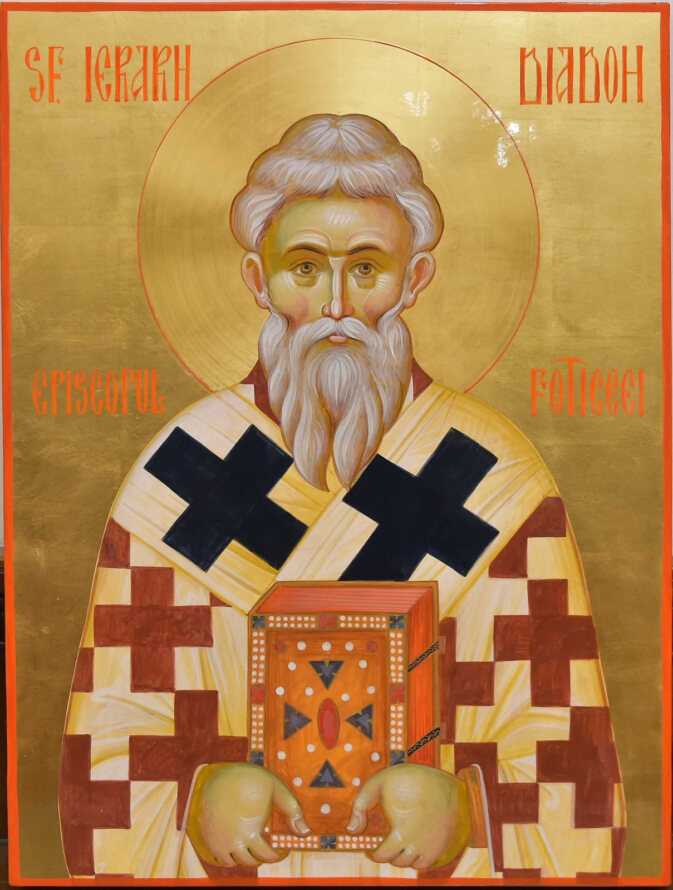
Saint Diadochos was born around 400 and served as the Bishop of Photiki in Epirus of Northern Greece. In 451, he took part in the Fourth Ecumenical Council of Chalcedon as Bishop of Photiki and supported Orthodoxy against the Monophysites.
His signature appears in a letter from 458 addressed to Emperor Leo I, in which he mentions the death of Patriarch Proterius of Alexandria, killed by the Monophysites.
Diadochos’ writing and ascetic practice were influenced by Evagrius the Solitary and Saint Macarius the Great, incorporating ideas of hesychia (stillness, rest, quiet), sensible spiritual experience, and the fierceness of the fight against the demons.
The One Hundred Chapters represent a complete treatise on the spiritual life, the ultimate goal of which is to unite the soul with God through love (chapters 1-2). His writings essentially contain dogmatic teachings and spiritual counsel.
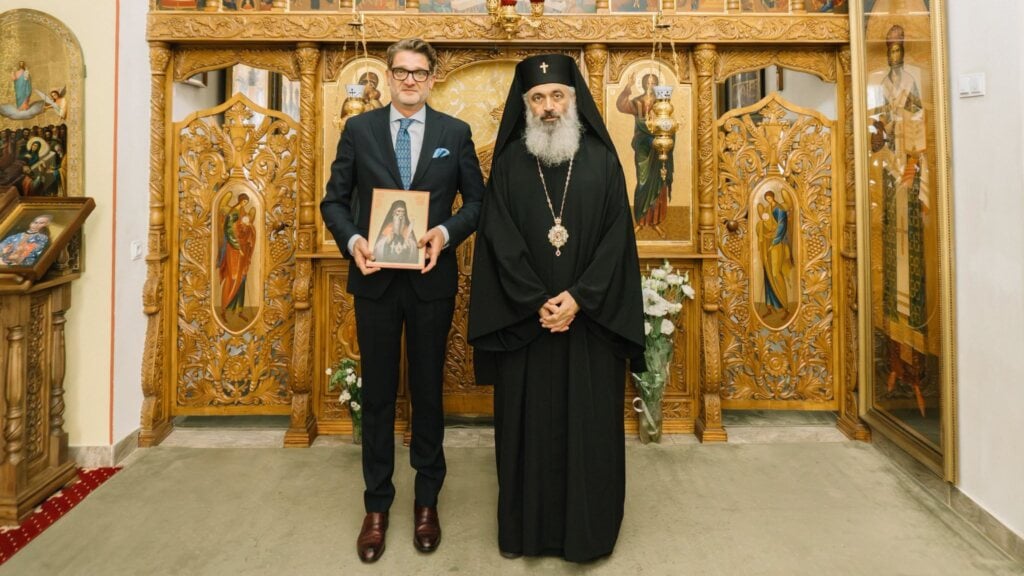
The registration of Saint Diadochos of Photiki in the calendar of the Romanian Orthodox Church has been approved in the working meeting of the Holy Synod in December 2021.
Troparion — Tone 4
You received the heavenly grace of the Spirit, and showed yourself to be a divine Archpastor of Photiki, Diadochos, with true wisdom and action you raised to virtue with the light of divine teaching those inspired by God, who cry unto to you: Glory to Christ who has glorified you, Glory to Him who has crowned you, Glory to Him who through you grants grace and mercy
5th Sunday of Great Lent (St Mary of Egypt)
St Mary of Egypt – Read the life.
Gospel
Mark 10: 32-45
Now they were on the road, going up to Jerusalem, and Jesus was going before them; and they were amazed. And as they followed they were afraid. Then He took the twelve aside again and began to tell them the things that would happen to Him:
“Behold, we are going up to Jerusalem, and the Son of Man will be betrayed to the chief priests and to the scribes; and they will condemn Him to death and deliver Him to the Gentiles;
and they will mock Him, and scourge Him, and spit on Him, and kill Him. And the third day He will rise again.”
Then James and John, the sons of Zebedee, came to Him, saying, “Teacher, we want You to do for us whatever we ask.”
And He said to them, “What do you want Me to do for you?”
They said to Him, “Grant us that we may sit, one on Your right hand and the other on Your left, in Your glory.”
But Jesus said to them, “You do not know what you ask. Are you able to drink the cup that I drink, and be baptized with the baptism that I am baptized with?”
They said to Him, “We are able.” So Jesus said to them, “You will indeed drink the cup that I drink, and with the baptism I am baptized with you will be baptized;
but to sit on My right hand and on My left is not Mine to give, but it is for those for whom it is prepared.”
And when the ten heard it, they began to be greatly displeased with James and John.
But Jesus called them to Himself and said to them, “You know that those who are considered rulers over the Gentiles lord it over them, and their great ones exercise authority over them.
Yet it shall not be so among you; but whoever desires to become great among you shall be your servant.
And whoever of you desires to be first shall be slave of all.
For even the Son of Man did not come to be served, but to serve, and to give His life a ransom for many.”
Luke 7: 36-50
Then one of the Pharisees asked Him to eat with him. And He went to the Pharisee’s house, and sat down to eat. And behold, a woman in the city who was a sinner, when she knew that Jesus sat at the table in the Pharisee’s house, brought an alabaster flask of fragrant oil, and stood at His feet behind Him weeping; and she began to wash His feet with her tears, and wiped them with the hair of her head; and she kissed His feet and anointed them with the fragrant oil.
Now when the Pharisee who had invited Him saw this, he spoke to himself, saying, “This Man, if He were a prophet, would know who and what manner of woman this is who is touching Him, for she is a sinner.” And Jesus answered and said to him, “Simon, I have something to say to you.” So he said, “Teacher, say it.” “There was a certain creditor who had two debtors.
One owed five hundred denarii, and the other fifty. And when they had nothing with which to repay, he freely forgave them both. Tell Me, therefore, which of them will love him more?” Simon answered and said, “I suppose the one whom he forgave more.” And He said to him, “You have rightly judged.” Then He turned to the woman and said to Simon, “Do you see this woman? I entered your house; you gave Me no water for My feet, but she has washed My feet with her tears and wiped them with the hair of her head. You gave Me no kiss, but this woman has not ceased to kiss My feet since the time I came in.
You did not anoint My head with oil, but this woman has anointed My feet with fragrant oil. Therefore I say to you, her sins, which are many, are forgiven, for she loved much. But to whom little is forgiven, the same loves little.” Then He said to her, “Your sins are forgiven.” And those who sat at the table with Him began to say to themselves, “Who is this who even forgives sins?” Then He said to the woman, “Your faith has saved you. Go in peace.”