Orthodox Calendar, June 15
Holy Prophet Amos
The Holy Prophet Amos, third of the Twelve Minor Prophets, lived during the eighth century before Christ. At this time the Hebrew nation was divided into two kingdoms: Judea and Israel. The Judean king Hosiah ruled in Jerusalem, but the ten separated Israelite tribes were ruled by Jeroboam II, an idol-worshipper. At Bethel he set up an idol in the form of a golden calf, which they worshipped, after they rejected the God of Israel.
The Prophet Amos was a Judean, from the city of Thecua in the land of Zebulon. Simple and untaught, but fervent in faith and zealous for the glory of the true God, this former shepherd and dresser of sycamore trees (Amos 7:14-15) was chosen by the Lord for prophetic service.
He was sent to the kingdom of Israel to denounce the impiety of King Jeroboam, and also the Israelites for falling away from God. The prophet predicted a great misfortune which would befall Israel and the neighboring pagan nations, because of their impiety. As a result of his denunciations, the Prophet Amos repeatedly suffered beatings and torture. He returned to Bethel, and threatening inevitable misfortunes, he continued to call the Israelites to repentance.
The idolatrous priest Amaziah of the pagan temple particularly hated the prophet. The prophet predicted speedy destruction for him and all his household, and for this he was subjected to beatings. Hosiah, the son of Amaziah, struck the saint on the head with a club and seriously wounded him. Still alive, the Prophet Amos reached his native village and died there around 787 B.C. He is not to be confused with Amos, the father of the Prophet Isaiah.
Troparion — Tone 2
We celebrate the memory / of Your prophet Amos, O Lord; / through him we entreat You, / “Save our souls.”
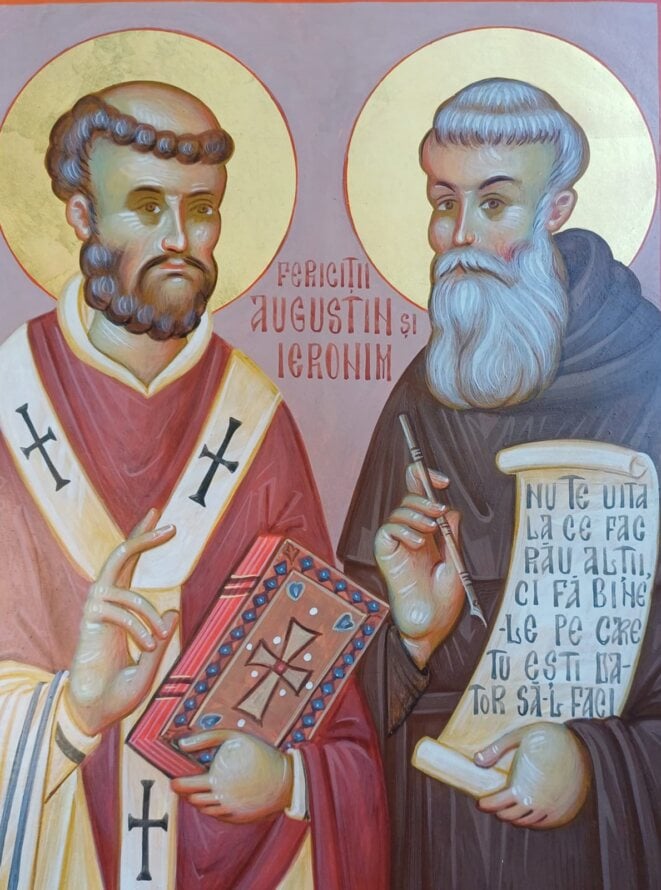
Blessed Augustine
Augustine was born in the city of Thagaste in northern Africa.
He was raised by his mother, Saint Monica (May 4), and he received his education at Carthage. In the capacity of professor of rhetoric, Augustine arrived at Milan, Italy where Saint Ambrose (December 7) was bishop.
Under the guidance of Saint Ambrose, Augustine studied the Holy Scriptures. The Word of God produced in his soul a radical crisis; he accepted holy Baptism, gave all his wealth to the poor and was tonsured as a monk.
In the year 391 Valerian, Bishop of Hippo, ordained Saint Augustine a priest, and in 395, appointed him vicar bishop of the see of Hippo. After the death of Bishop Valerian, Saint Augustine took his place.
During his 35 years as bishop, Saint Augustine wrote many works devoted to combating the Donatist, Manichaean and Pelagian heresies.
Saint Augustine wrote many works (according to his student and biographer Possidias, the number approached 1030). Of his works the best known are: The City of God (De civitate Dei), The Confessions, 17 Books against the Pelagians and Handbook of Christian Knowledge (The Enchiridion). Saint Augustine was concerned above all else that his writings be intelligent and edifying. “It is better,” he said, “for them to condemn our grammar, than for people not to understand.” Saint Augustine died on August 28, 430.
Saint Jerome (Hieronymus) of Stridion
Saint Jerome of Stridon was born into a Christian family in the city of Stridon, located on the border between Dalmatia and Pannonia. His full name is Eusebius Hieronymos Sophronius. His parents sent him to Rome, where he studied the secular sciences. At the beginning of his life in the capital, the youth was captivated by worldly vanities and fell into temptation. At the end of his time in Rome, Jerome resolved to change his life and to live in goodness and purity. When the youth was about 20 years old, he accepted holy Baptism. After this, he visited Gaul (France). Then Saint Jerome decided to dedicate himself totally to God and to become a monk.
In about the year 372, Saint Jerome returned to his native city, but his parents had already departed this life. On him fell the responsibility of raising his younger sisters and his brother Paulinian. These cares forced him to put aside his plans to enter a monastery, at least for a time.
Having made arrangements for the care of his siblings, he journeyed to the East with several of his friends. In 374, he decided to dwell in the desert of Chalcis, southeast of Antioch. There he remained for about 5 years, combining work on the Holy Scriptures with austere ascetic deeds. Besides this, Saint Jerome mastered the Hebrew and Chaldean languages. During this period, he began corresponding with numerous people on a variety of topics. About 120 letters, considered as authentically written by Saint Jerome, have been preserved.
At the beginning of the 360s, a controversy arose between the proponents of the bishops Meletius, Paulinos, and Vitalis. The controversy also reached the monastery where Saint Jerome toiled. As a result, the disputes led him to leave the monastery and go to Antioch. Here Bishop Paulinos ordained him to the priesthood. Afterwards, Saint Jerome visited Constantinople and conversed with the holy hierarchs Gregory the Theologian and Gregory of Nyssa. In the year 381, he set off for Rome. In Rome, he continued his studies. The holy Pope Damasus I (366-384), who also devoted much of his time to the study of Holy Scripture, made Jerome his secretary.
But because the saint denounced the morals of the contemporary Christian society, a whole party of those bearing malice towards the saint came forward to spread slanders about him. After a three year stay at Rome, Saint Jerome felt compelled to abandon this city for good. Together with his brother Paulinian and friends, Saint Jerome visited the Holy Land, and also the monks of the Nitria wilderness monastery. In the year 386 he settled into a cave at Bethlehem near the cave where Christ was born, and there he began a life of austere asceticism.
This was the period of his creative activity’s blossoming. In line with the studies of his time, Saint Jerome left the Church a rich written legacy: collections of dogmatic-polemic works, moral-ascetic works, commentaries on Scripture, and historical works. But the most important of his works was a new translation the books of the Old and New Testaments into the Latin language. This Latin translation, called the “Vulgate,” became the standard throughout the Western Church.
Saint Jerome lived through the fall of his beloved city, Rome, which was sacked by the Goths in the year 410. In the year 411 a new ordeal beset the saint, Bethlehem was invaded by wild Bedouin Arabs. Only through the mercy of God was the community of the aged ascetic saved from complete destruction. He finished his life in the cave in Bethlehem. Saint Jerome is believed to have reposed in 420. His relics were transferred from Bethlehem to Rome in 642, but their present location is unknown. His hand is enshrined in a church near Rome’s Piazza Farnese.
Translated into English by oca.org.