Orthodox Calendar, September 28
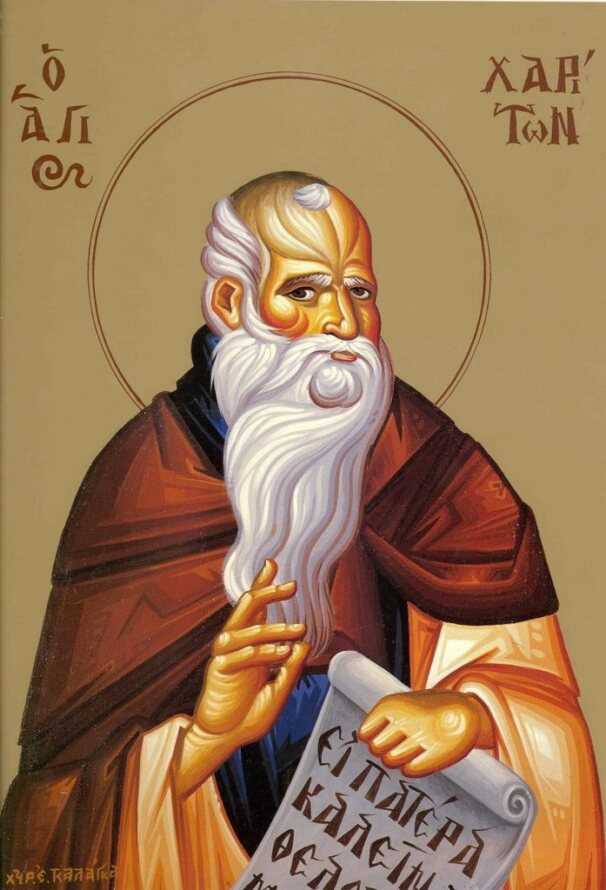
Saint Chariton the Confessor
He was born at Iconium in the province of Lycaonia, and suffered there during a persecution against Christians in the reign of Emperor Aurelian (270-275).
The example of the holy Protomartyr Thekla (September 24), who was also a native of his city, encouraged him to confess Christ, since he had a great devotion to her.
Saint Chariton bravely denounced the pagan gods and staunchly confessed faith in the one True God, Christ the Savior. The holy Confessor underwent fierce tortures but, by God’s Providence, he survived. The persecution ended after Aurelian’s death in 275.
Saint Chariton was among the many Christians who were released from prison, and he resolved to dedicate his entire life to the service of the Lord. Although he escaped death, he grieved because he had not received the crown of martyrdom.
After arriving at Jerusalem on a pilgrimage to the holy places, he fell into the hands of thieves. They tied him up and threw him in a cave, intending to kill him later.
After they left to find people to rob, the saint prayed fervently to God expecting to be put to death. He did not ask God to deliver him, but instead he entreated Him to do with him as He wished.
At this time a snake crawled into the cave and began to drink wine from a vessel setting there. Later it vomited forth its deadly venom, poisoning the wine. When they returned to the cave, the evil men drank the poisoned wine and they all perished.
Thus, their wicked lives came to a fitting end. Saint Chariton gave thanks to God, and then he gave away the gold which the malefactors had stolen, distributing it to the poor, to churches, and to monasteries. He began his ascetic struggles in the place of his miraculous rescue, and there he built a church.
In time a monastery was established: the renowned Pharan Lavra in Palestine. Saint Chariton’s fame drew many disciples to him. He governed them with paternal affection, and he elevated them to the highest degrees of virtue.
Saint Chariton compiled a strict Rule for his monastery. Yearning for solitude, the monk withdrew farther into the desert in order to avoid the praise of men, but he never rejected anyone who sought his spiritual guidance.
He founded two more monasteries: the Jericho (called the Monastery of Saint Chariton) and the Souka, which was called “the old Lavra.” He also brought many Jews and pagans to the Faith.
At the end of his life, Saint Chariton struggled in a cave atop a hill near the Souka monastery, but he did not cease to provide guidance for all three of the monasteries which he founded. He fell asleep in the Lord peacefully and at an advanced age on September 28, 350.
According to Tradition, Saint Chariton compiled the Office of the Monastic Tonsure. Saint Chariton was buried at the Pharan monastery, in accordance with his last wishes. His grace-filled relics were enshrined in the church that had been built on the site of the robbers’ cave.
Troparion — Tone 8
By a flood of tears you made the desert fertile, / and your longing for God brought forth fruits in abundance. / By the radiance of miracles you illumined the whole universe! / Our Father Chariton, pray to Christ God to save our souls!
Holy Prophet Baruch
He was an inseparable companion, disciple, friend and scribe of the great Prophet Jeremiah (May 1). He wrote an entire scroll of his prophetic sayings and read them to the people in the Temple of Jerusalem.
Together with his teacher, Saint Baruch grievously lamented the destruction of Jerusalem by Nebuchadnezzar, and he taught and censured the Jews, and he suffered spite and vexation from them. He witnessed the stoning of the holy Prophet Jeremiah, and buried his body.
After the martyr’s death of the Prophet Jeremiah, Saint Baruch lived a short while and died in Egypt, in the sixth century before Christ. The holy Prophet Baruch prophesied the return of the Jews from the Babylonian Captivity, and the desolation of Babylon.
He clearly prophesied the coming into the world of the Son of God, Who would “dwell with mankind.” His prophecy begins with the words, “He is our God, and no other can compare with Him” (Bar 3:36).
The Book of the Prophet Baruch is regarded as uncanonical and is appended to the Book of the Prophet Jeremiah. On the eve of the Nativity of Christ it is read as one of the Old Testament readings, listed as a prophecy of Jeremiah.
Troparion — Tone 8
You were worthy of the light of prophecy / becoming a companion to Jeremiah. / You foretold the self-emptying of God the Word / which he wrought for the salvation of the world. / Now all heirs of his kingdom honor you, O holy Prophet Baruch!
Sunday, September 24, 2021– 18th Sunday After Pentecost
Tr by oca.org