Orthodox Calendar – The Holy Trinty
On the day after every Great Feast, the Orthodox Church honors the one through whom the Feast is made possible. On the day following the Nativity of the Lord, for example, we celebrate the Synaxis of the Most Holy Theotokos (December 26). On the day after Theophany, we commemorate Saint John the Baptist (January 7), and so on.
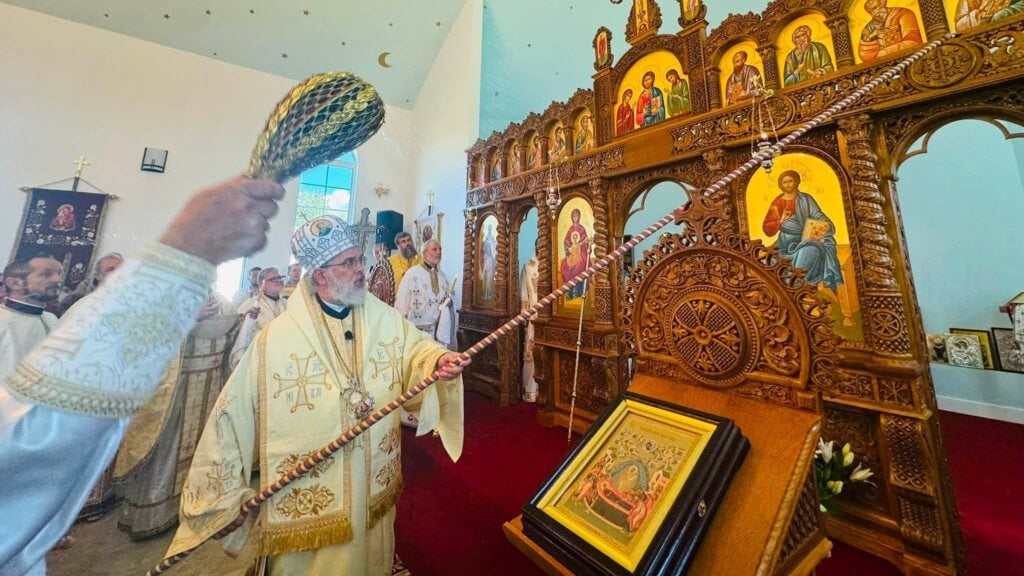
Today we honor the all-Holy, good, and life-creating Spirit, Who descended upon the Apostles at Pentecost in the form of fiery tongues in fulfillment of the Lord’s promise to send the Comforter to His disciples (JN 14:16). That same Holy Spirit remains within the Church throughout the ages, guiding it “into all truth” (JN 16:13).
One of the hymns at Vespers on Saturday evening tells us that the Holy Spirit “provides all things. He gushes forth prophecy, He perfects the priesthood, … He holds together the whole institution of the Church.”
At Vespers on the day of Pentecost, we hear that the Holy Spirit is “the Fountain of goodness, through Whom the Father is known, and the Son is glorified.” He is “the living Fountain of spiritual gifts” Who “purifies us from our sins.” It is by the Holy Spirit that “the prophets, divine Apostles, and martyrs are crowned.” He is the source of life and of sanctification.
In the services of this day, we sing the same hymns as on Pentecost, except the Canon of the Holy Spirit, which is sung at Compline. The Vigil is not prescribed for the eve of today’s feast. We sing the Great Doxology at Matins, but not the Polyeleos. The Irmos of the Ninth Ode (“Hail, O Queen, glory of mothers and virgins…”) is sung in place of the Song of the Theotokos (“My soul magnifies the Lord…”).
At the Liturgy, the priest or deacon chants the Entrance Verse (“Be exalted in Thy strength, O Lord. We will sing and praise Thy power.”) as on the day of Pentecost. “Holy God” replaces “As many as have been baptized….” The dismissal of Pentecost is also used.
This whole week is fast-free, and the Leave-taking of Pentecost occurs on Saturday.
Troparion, tone 8:
Blessed are You O Christ Our God / You have revealed the fishermen as most wise / by sending down upon them the Holy Spirit / through them You drew the world into Your net / O Lover of Man, Glory to You!
Martyr Justin the Philosopher and those with him at Rome
The Holy Martyr Justin the Philosopher was born around 114 at Sychem, an ancient city of Samaria. Justin’s parents were pagan Greeks. From his childhood the saint displayed intelligence, love for knowledge and a fervent devotion to the knowledge of Truth.
When he came of age he studied the various schools of Greek philosophy: the Stoics, the Peripatetics, the Pythagoreans, the Platonists, and he concluded that none of these pagan teachings revealed the way to knowledge of the true God.
Once, when he was strolling in a solitary place beyond the city and pondering about where to seek the way to the knowledge of Truth, he met an old man. In the ensuing conversation he revealed to Justin the essential nature of the Christian teaching and advised him to seek the answers to all the questions of life in the books of Holy Scripture.
“But before anything else,” said the holy Elder, “pray diligently to God, so that He might open to you the doors of Light. No one is able to comprehend Truth, unless he is granted understanding from God Himself, Who reveals it to each one who seeks Him in prayer and in love.”
In his thirtieth year, Justin accepted holy Baptism (between the years 133 and 137). From this time Saint Justin devoted his talents and vast philosophical knowledge to preaching the Gospel among the pagans. He began to journey throughout the Roman Empire, sowing the seeds of faith. “Whosoever is able to proclaim Truth and does not proclaim it will be condemned by God,” he wrote.
Justin opened a school of Christian philosophy. Saint Justin subsequently defended the truth of Christian teaching, persuasively confuting pagan sophistry (in a debate with the Cynic philosopher Crescentius) and heretical distortions of Christianity. He also spoke out against the teachings of the Gnostic Marcian.
In the year 155, when the emperor Antoninus Pius (138-161) started a persecution against Christians, Saint Justin personally gave him an Apology in defense of two Christians innocently condemned to execution, Ptolemy and Lucias. The name of the third remains unknown.
In the Apology he demonstrated the falseness of the slander against Christians accused unjustly for merely having the name of Christians. The Apology had such a favorable effect upon the emperor that he ceased the persecution.
Saint Justin journeyed, by decision of the emperor, to Asia Minor where they were persecuting Christians with particular severity. He proclaimed the joyous message of the imperial edict throughout the surrounding cities and countryside.
The debate of Saint Justin with the Rabbi Trypho took place at Ephesus. The Orthodox philosopher demonstrated the truth of the Christian teaching of faith on the basis of the Old Testament prophetic writings. Saint Justin gave an account of this debate in his work Dialogue with Trypho the Jew.
A second Apology of Saint Justin was addressed to the Roman Senate. It was written in the year 161, soon after Marcus Aurelius (161-180) ascended the throne.
When he returned to Italy, Saint Justin, like the Apostles, preached the Gospel everywhere, converting many to the Christian Faith. When the saint arrived at Rome, the envious Crescentius, whom Justin always defeated in debate, brought many false accusations against him before the Roman court.
Saint Justin was put under guard, subjected to torture and suffered martyrdom in 165. The relics of Saint Justin the Philosopher rest in Rome.
In addition to the above-mentioned works, the following are also attributed to the holy martyr Justin the Philosopher: An Address to the Greeks, A Hortatory Address to the Greeks, On the Sole Government of God.
Saint John of Damascus preserved a significant part of Saint Justin’s On the Resurrection, which has not survived. The church historian Eusebius asserts that Saint Justin wrote books entitled The Singer, Denunciation of all Existing Heresies and Against Marcian.
The holy martyrs Justin, Chariton, Euelpistus, Hierax, Peonus, Valerian, Justus and the martyr Charito suffered with Saint Justin the Philosopher in the year 166.
They were brought to Rome and thrown into prison. The saints bravely confessed their faith in Christ before the court of the prefect Rusticus.
Rusticus asked Saint Justin, whether he really thought that after undergoing tortures he would go to heaven and receive a reward from God. Saint Justin answered, “Not only do I think this, but I know and am fully assured of it.”
The prefect proposed to all the Christian prisoners that they offer sacrifice to the pagan gods. When they refused he issued a sentence of death, and the saints were beheaded.
Troparion, tone 4:
O Justin, teacher of divine knowledge, you shone with the radiance of true philosophy. You were wisely armed against the enemy. Confessing the truth you contended alongside the martyrs, with them, ever entreat Christ our God to save our souls!
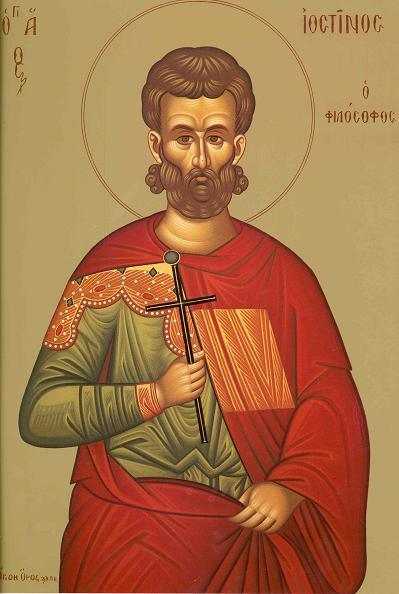
Photo: Florentina Mardari